The initial suffering of the early 2020s is officially over. As we move through 2026, Artificial Intelligence has shifted from a flashy boardroom PowerPoint slide to the very central nervous system of modern business. In fact, official OECD data shows that firm AI adoption has more than doubled since 2023, now reaching over 20% of all enterprises. While access to AI tools surged by 50% last year, only about 34% of leaders report they are truly reimagining their business models. Most are still just scratching the surface.
If you are a manufacturing head, an operations lead, or a business owner, you aren’t just looking for “neat” tech. You are looking for a competitive edge. You need to know how to navigate AI adoption challenges and build a robust Enterprise AI strategy that actually moves the needle.
Let’s dive into the roadmap for scaling AI in your organization.
The Reality of AI Deployment
AI is not the future. It is the present. But successful AI adoption? That is still a work in progress. Over the last two years, I have seen boardrooms move from curiosity to urgency. In 2024, leaders asked, “What is our AI strategy?” In 2025, they approved pilots. In 2026, they are asking a sharper question, “Where is the measurable business impact?”
That shift matters.
According to McKinsey’s latest global survey, more than half of organizations are using AI in at least one function. Yet only a small fraction say it has significantly improved their bottom line. That gap is where most AI deployment challenges live.
Think of AI implementation like upgrading a high-speed locomotive while it is still rolling down the tracks. You can’t stop the train (your daily operations), but if you don’t upgrade the engine (your tech stack), you will eventually run out of fuel.
Despite the hype, overcoming the AI adoption barriers remains difficult. According to recent 2026 industry reports, the top barriers aren’t just about the “math” behind the models, they are about the “muscle” of the organization:
1. The Skills Chasm
A staggering 70.9% of enterprises cite a lack of relevant expertise as their #1 obstacle. We have the tools, but we don’t always have the “AI-fluent” workforce to wield them.
2. Data Chaos
Many organizations find their data is siloed across five different legacy systems. AI thrives on clean, streaming data; if your data is “messy,” your AI will be “moody.”
3. Governance Gaps
With the rise of Agentic AI, autonomous agents that can actually execute tasks, only 1 in 5 companies has a mature framework to govern these digital workers.
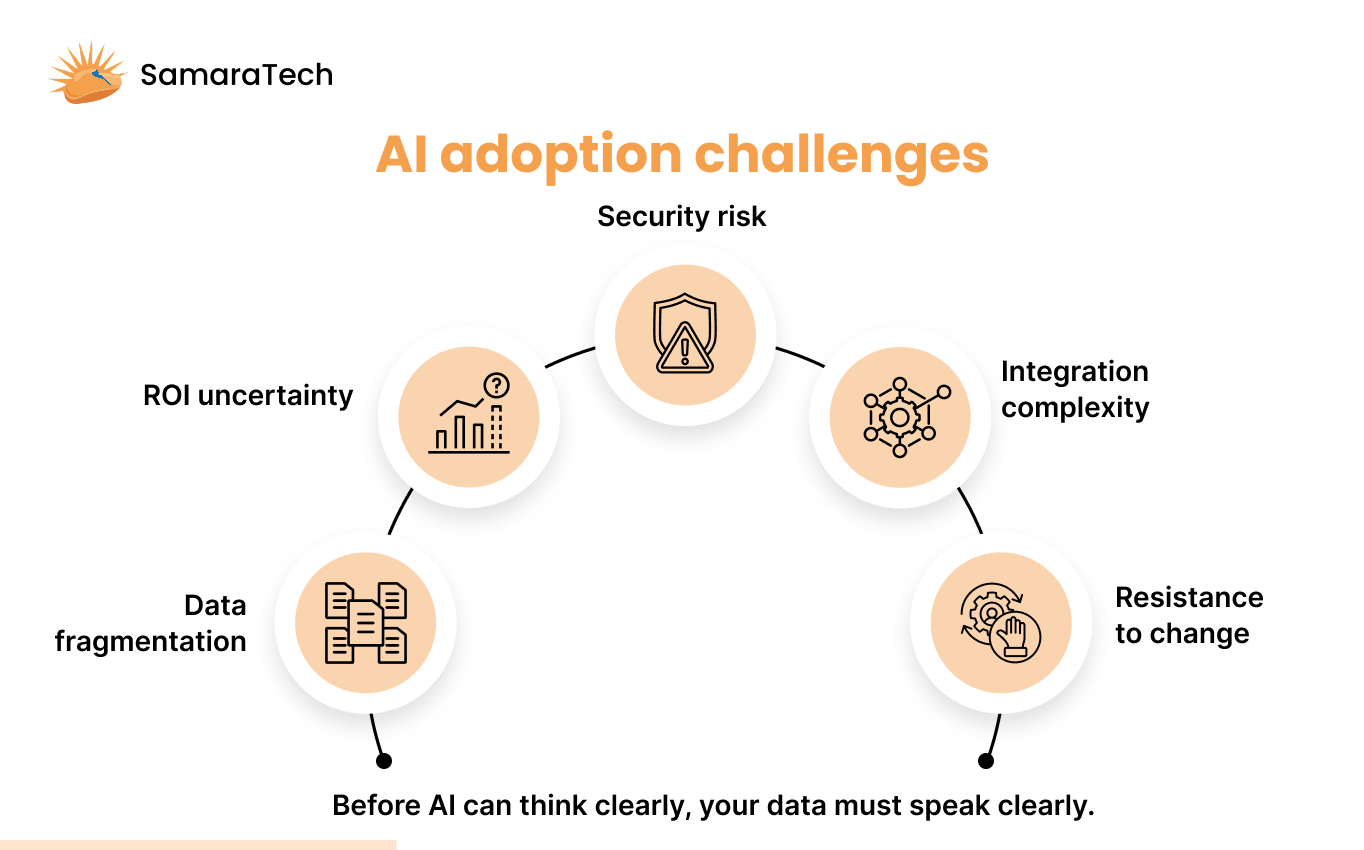
AI Deployment Challenges
AI works beautifully in controlled demos. Real businesses are not controlled demos.
You run on legacy systems. You manage compliance risk. You handle sensitive Customer data. You deal with human resistance. You answer to boards and auditors. AI has to fit into that reality. And that is where things slow down.
1. The “Garbage In, Garbage Out” Problem
AI works on data. If your business data is messy, outdated, incomplete, or scattered across systems, AI will also give confusing results.
It is like asking a very intelligent person to solve a problem, but giving them wrong information. Many companies in 2026 still don’t have clean, organised data. So AI struggles to give accurate answers.
2. Fear Around Data Privacy and Security
AI systems often need access to company data. That makes leaders nervous.
Questions arise:
- Is our confidential data safe?
- What if sensitive customer data leaks?
- Are we following the law?
Governments are also introducing strict rules. For example, the EU AI Act in Europe and India’s Digital Personal Data Protection Act demand stronger protection of personal data.
So companies move slowly because they don’t want legal trouble.
3. People Don’t Fully Trust AI Yet
Employees often worry:
- Will AI replace my job?
- Is this monitoring me?
- Do I need to learn something complicated?
If people feel threatened, they resist. And when employees don’t use the tools properly, AI investments go waste. In 2026, the biggest challenge is not technology. It’s human mindset.
4. It’s Expensive If Not Planned Properly
AI isn’t just buying a software subscription. You need:
- Infrastructure
- Experts
- Security controls
- Ongoing monitoring
If companies don’t see clear financial benefits, they hesitate. Business leaders now ask one simple question:
“Will this AI actually save money or increase revenue?”
If the answer is unclear, adoption slows down.
5. Old Systems Don’t Easily Connect
Many businesses still use old software systems built years ago. AI tools are modern. Old systems are not. Connecting both is not always smooth.
It’s like trying to connect a brand-new smartphone to a 15-year-old computer. Possible? Yes. Easy? Not always.
6. Ethical Concerns
AI sometimes makes biased decisions if the data it learns from is biased. For example:
- Hiring decisions
- Loan approvals
- Insurance risk calculations
Companies now have to ensure AI decisions are fair and explainable. Otherwise, it damages reputation.
AI Adoption Strategies for Enterprise Success in 2026
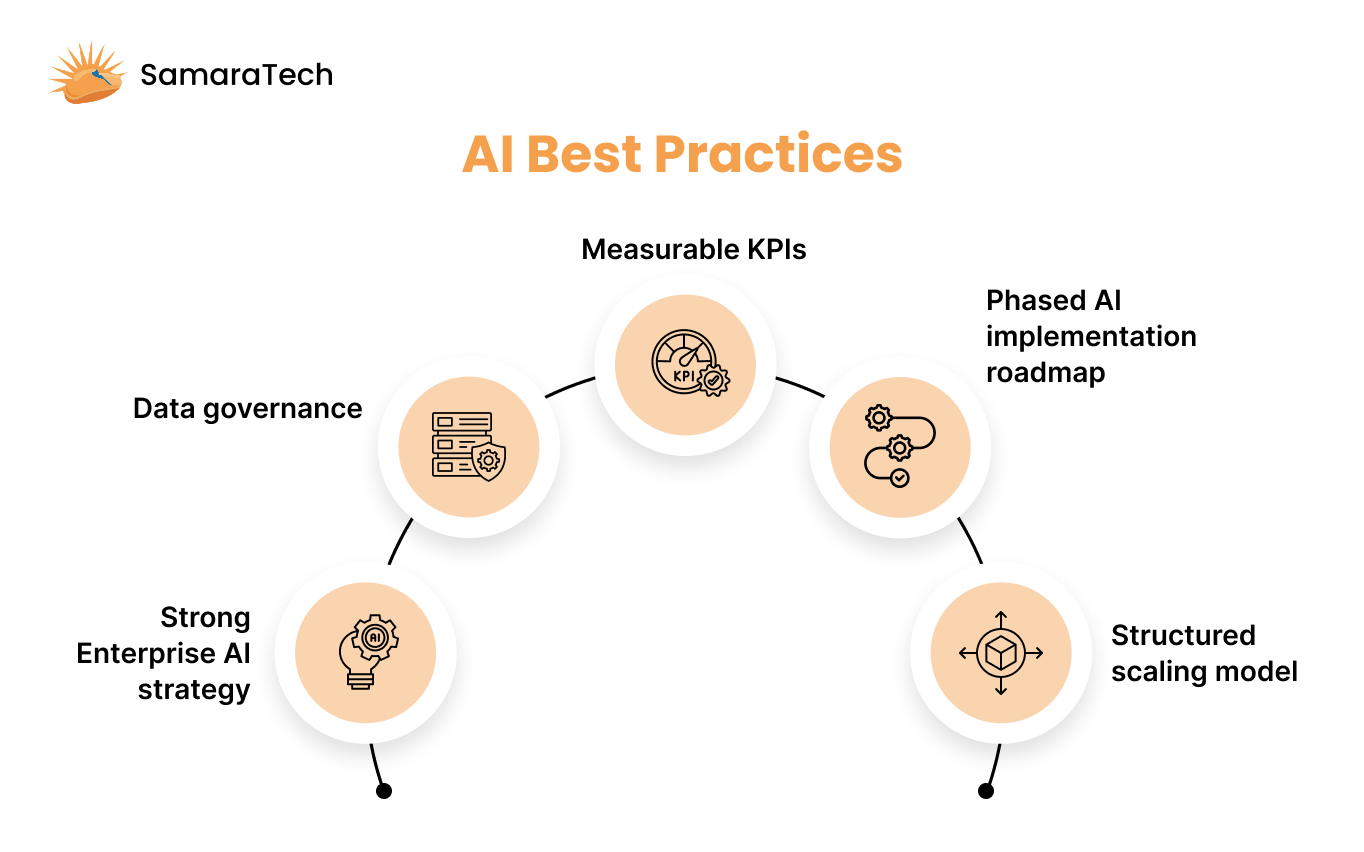
The most successful Enterprise AI implementation roadmap begins with a clear operational pain point. Maybe your demand forecasting is inaccurate. Maybe your compliance reporting takes too long. Maybe your downtime is increasing. Maybe procurement cycles are inefficient.
Define the problem first. Attach measurable targets. Then align AI to that objective.
Organizations focusing on high-value use cases are far more likely to see financial impact and maximizing business value from AI. That is not theory. It is visible in every serious transformation program.
1. Start With a Business Problem and Not With AI
Many companies still make this mistake. They buy AI tools first. Then they look for a use case. That rarely works.
Instead, ask:
- Where are we losing money?
- Where are decisions slow?
- Where are errors frequent?
- Where is manual effort high?
In 2026, successful enterprises start with one focused, measurable problem. For example:
- Reducing procurement delays
- Improving demand forecasting
• Automating compliance reporting
• Enhancing customer response time
Then, AI becomes a solution, not a science project. AI best practices are a must for scaling AI in organizations.
Oracle AVDF consolidates audit logs from multiple sources, Oracle databases, non-Oracle databases, operating systems, and directories. You see every user, action, and access attempt in one place.
This level of visibility reduces blind spots, which is critical because 51% of breaches go undetected for months.
2. Fix Your Data Foundation First
AI runs on data. So your data must be clean, structured, governed, accessible. In 2026, enterprises that succeed with AI invest heavily in:
- Data standardization
- Master data management
- Clear ownership of data
- Strong data governance frameworks
Without this foundation, AI outputs become unreliable. Data is the fuel for your organistaion. High-quality fuel ensures performance. Poor fuel damages engines.
3. Build AI Governance Early
Regulations are tightening globally. The EU AI Act and India’s Digital Personal Data Protection Act are pushing enterprises to be more responsible.
Smart enterprises now establish:
- AI usage policies
- Data access controls
- Model monitoring systems
- Clear accountability
Governance is not bureaucracy. It protects the organization from reputational and legal risk. Boards now ask about AI risk the same way they ask about financial risk.
4. Upskill People, Don’t Replace Them
AI adoption fails when employees feel threatened. Successful enterprises in 2026:
- Train teams to work with AI
- Clarify that AI supports, not replaces
- Introduce AI gradually into workflows
- Reward adoption and experimentation
When employees trust the system, adoption accelerates. AI works best when humans remain in control.
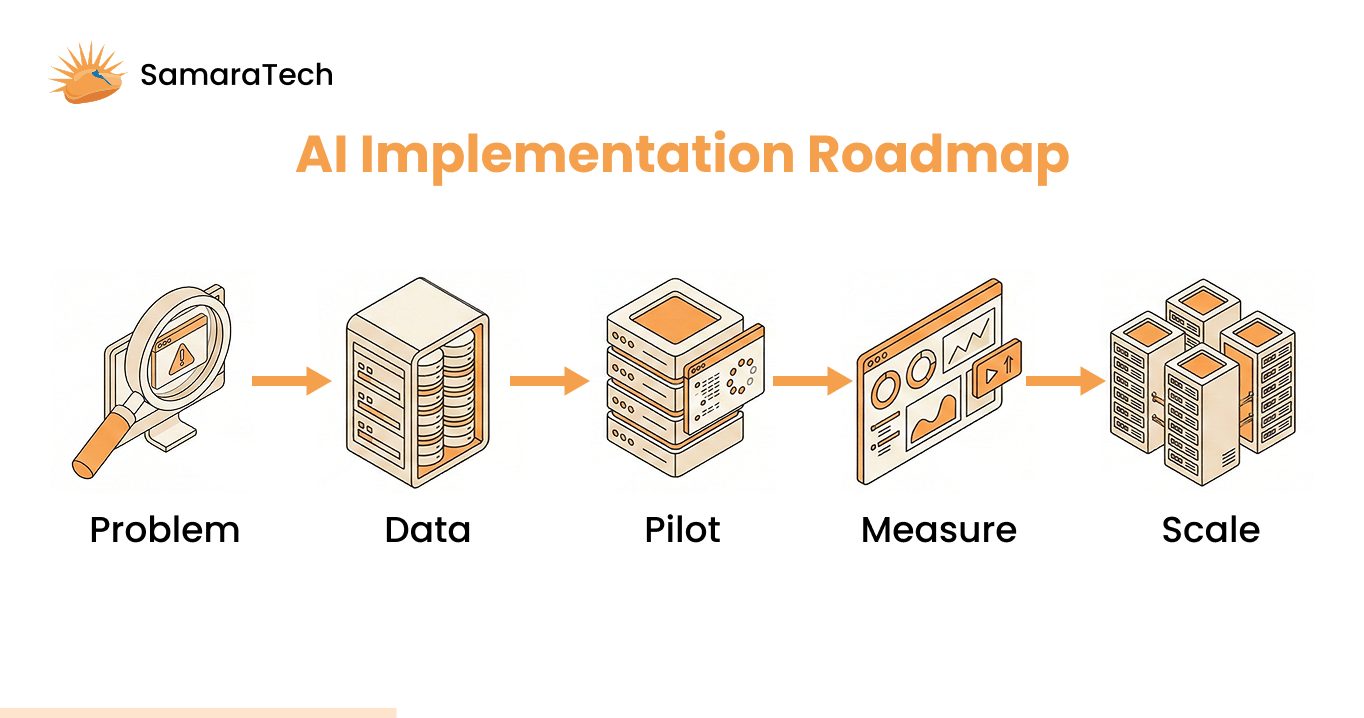
5. Start Small. Scale Fast.
Don’t roll AI across the entire enterprise on day one.
Instead:
- Run a focused pilot.
- Measure impact.
- Improve the model.
- Scale to other departments.
In 2026, enterprises that win with AI treat it like a phased transformation. Quick wins build internal confidence.
6. Measure ROI With Clear KPIs
AI must show measurable impact. Define metrics before implementation:
- Cost reduction percentage
- Time saved per process
- Revenue uplift
- Error reduction rate
- Productivity improvement
If you can’t measure it, you can’t justify it. In 2026, AI is board-level investment. It must demonstrate financial value.
7. Integrate AI Into Core Systems, Not Side Projects
AI must connect with ERP systems, CRM platforms, Supply chain tools, and Finance systems. If AI sits outside core systems, it becomes underused. For scaling AI in organizations, it is essential that AI become part of daily workflow, not an optional tool.
So what’s the real issue in 2026?
AI is powerful. But using AI responsibly inside a real business requires:
- Clean data
- Strong security
- Clear business goals
- Employee training
- Proper budgeting
- Leadership alignment
Most companies are not failing because AI doesn’t work. They struggle because AI needs preparation, discipline, and change management. Think of AI like a high-performance car. If the road is broken, the driver is untrained, and the fuel is dirty, even the best car won’t perform.
AI is ready in 2026. However, many businesses are still getting ready for AI.
SamaraTech and askme360
At SamaraTech, we work with enterprises to bridge the gap between AI ambition and AI execution. Our approach focuses on structured Enterprise AI adoption, governance-driven deployment, and measurable outcomes. Through askme360, our AI-powered enterprise intelligence platform, we enable leadership teams to access contextual insights directly from their ERP and operational systems, securely and in real time. Instead of waiting for manual reports, you interact with your data conversationally and make faster, informed decisions. Because in 2026, AI should not just exist in your enterprise. It should actively drive it.
FAQs on AI Adoption Challenges
Q1: What are the biggest AI adoption challenges in 2026?
The biggest AI adoption challenges in 2026 are poor data quality, unclear ROI, integration with legacy systems, security risks, and employee resistance.
Most enterprises struggle not because AI lacks capability, but because their data, governance, and systems are not fully prepared to support it at scale.
Q2: Why do enterprises struggle with AI implementation?
Enterprises struggle because they start with technology instead of business problems.
Without clear KPIs, strong data foundations, leadership alignment, and a structured AI implementation roadmap, projects remain pilots and fail to scale.
Q3: How can businesses overcome AI adoption barriers?
Businesses can overcome AI adoption barriers by focusing on high-impact use cases, strengthening data governance, running controlled pilots, measuring ROI clearly, and training teams to work with AI.
Structured execution turns experimentation into enterprise value.
Q4: What role does governance play in AI adoption?
Governance ensures AI is secure, compliant, and accountable.
It defines data access, monitors risk, enforces regulatory compliance, and builds leadership trust. Without governance, AI becomes a risk. With governance, it becomes a strategic asset.